Plastic artist
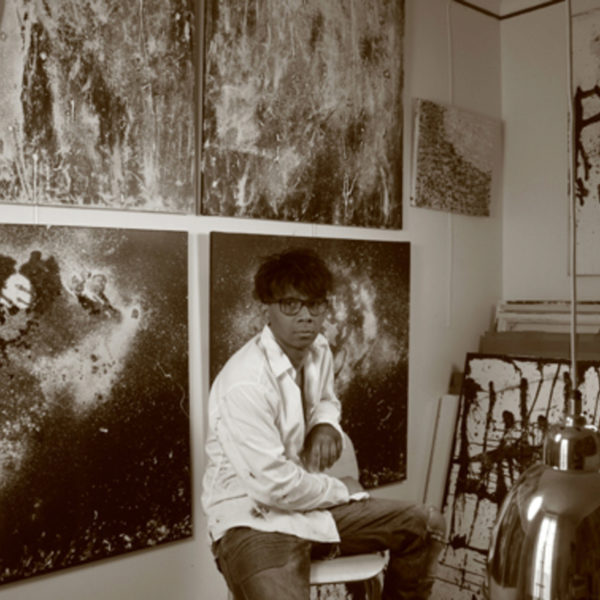
His colors are like scents, and his lines slashes—tightened by too great a desire to love. In this blend, there is no journey, no folklore, but there are intense encounters—poised and raw. Therefore, when the bitter taste becomes too strong, the artist scribbles, paints, lies on the canvas and leaves us to our astonishment. Meanwhile, in a disarming burst of laughter, he leaves for a world of fantasy, filled with eternal adolescents, a couple of sel- fish angels, Peter Pan and the Little Prince—a modern world made of fashion, virtuality, lightness, mélanges and creativity. Everything in his production is unbalanced, therefore in movement. When looking at a painting by Thierry Esther, one feels as if interpellated, yet unfulfilled. The artist has rid himself of his anguish, of an overpowering feeling of happiness, of a shadow of the past, or an excessively pressing feeling and he leaves an image which everyone of us makes his. And from that point, we go on with our own story. Masala (mixtures in Hindi) In Thierry Esther’s work, as in that of any artist who is influenced by his times and emotions, one can recognize a chain of periods, characterized by different styles and series. However, they all overlap, go, come back and mingle. His various influences will not go unnoticed by the “dissection specialists” who feel the need to categorize everything. It must be said that he has not been trained in an academy. He is self-made, and his inspiration comes from his coup de Coeur and the objects of his love; hence his freedom of style and the freshness of his enthusiasm. The sea and the air are more his elements than the pavement is—elements where everything flows and dissolves. He personally pictures himself as an angel or a bird—an angel who is sometimes despaired, most often ironic but always amused and in love—in-between two beings. This ambiguity between pain and bliss is the sign of an eternal youth—which he touchingly preserves and which he restitutes in his painting with amazing vivacity. When looking at his work, the most “solemn” of us find themselves exposed just as Saint-Exupéry’s pilot who has broken down and is certain to have a mission to accomplish, although he no longer knows how he should reply to the Little Prince’s simple questions. Métissage (Blend) Mixed complexion, mixed culture. Thierry Esther is a reflection of our world—made of free electrons, hungry for love and pleasure. His optimistic and insatiable modernity makes us appreciate life as it is—pleasure and pain—without any sectarian reference to a thinking system or a civilization. As he had experienced painful separations, changes and disparities, during his youth, he learned to protect himself and to organize his life in isolation. He has different facets, numerous life experiences, and a personality which is both rich and self- contradictory. He seduces his audience and showcases himself with skill, but he never opens up totally. The fruit of his blending does not lead to standardization. On the contrary, in its own complexity, it reaches a form of universality that is well rooted in our time. Thierry Esther used to paint periodically, almost in secret. Today, he reveals himself, as if to fully come to terms with himself, and give away some of who he is.
http://www.peinturemusiquepoussiere.com/ http://www.esthyphotography.com/ http://www.voyageblanc.com/